- AI Leadership
- Capital Markets
- Global Finance
- World Economic Forum
Larry Fink Put Davos Back at the Center of Global Power
12 minute read
After years of introspection, the World Economic Forum returns to relevance as technology convergence and macroeconomic transformation demand the collaborative platform it was designed to provide.
Key Takeaways
- The 2026 gathering marked a return to influence as artificial intelligence and infrastructure challenges created demand for the cross-sector dialogue Davos uniquely enables among corporate leaders and capital allocators.
- Record CEO participation and unprecedented representation from AI pioneers elevated computational infrastructure and semiconductor advancement to central economic considerations alongside traditional financial and policy discussions.
- Leading executives from NVIDIA, Microsoft, and Tesla emphasized energy constraints and implementation challenges over theoretical capabilities, grounding optimism in operational realities and near-term productivity applications.
The Return to Relevance
Something shifted in the Alpine air this January. The World Economic Forum’s annual meeting in Davos-Klosters arrived not as ritual but as necessity, reclaiming its position as the indispensable venue for parsing technological disruption and economic transformation. Nearly 3,000 participants from 130 countries descended on the Swiss enclave, drawn by forces that made the gathering genuinely consequential rather than merely ceremonial.
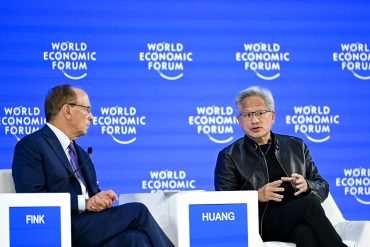
The numbers told part of the story: 850 chief executives and chairpersons, 100 unicorn founders, sovereign wealth fund managers controlling trillions in assets. But composition mattered more than attendance. OpenAI’s Sam Altman and Anthropic’s Dario Amodei shared panels with JPMorgan Chase’s Jamie Dimon and Goldman Sachs’ David Solomon. NVIDIA’s Jensen Huang engaged directly with BlackRock’s Laurence Fink, the Forum’s co-chair whose firm reported $212 billion in fourth-quarter inflows alone. This convergence of established financial power and emerging technological leadership created conditions for substantive exchange that recent iterations had struggled to achieve.
The Forum’s renaissance stems from recognition that the present moment defies unilateral comprehension. Artificial intelligence has moved from abstraction to operational imperative. Supply chains remain in flux from pandemic disruptions and geopolitical realignments. Energy transitions proceed unevenly across regions and sectors. No single institution commands sufficient perspective to navigate these intersecting currents. Davos regained relevance by offering what markets and governments separately cannot: a platform where capital allocators, technology builders, and policy architects confront shared challenges without predetermined outcomes.
Technology as Central Narrative
The 2026 agenda reflected this reorientation. Where previous gatherings dispersed attention across diffuse themes, this edition concentrated on artificial intelligence and the infrastructure required to deploy it at scale. The focus proved warranted. NVIDIA’s data center revenues surged 154 percent year-over-year in fiscal 2025, reaching $79.1 billion as cloud providers raced to expand computational capacity. The company’s Blackwell GPU platform, launched in March, doubled inference performance while halving power consumption, a technical achievement with profound economic implications.
Huang characterized the current AI buildout as unmatched in human history, positioning advanced semiconductors as strategic assets comparable to energy reserves or shipping lanes. His keynote addressed industrial applications directly, advocating robotics integration as manufacturing costs rise and demographic pressures intensify. Partnerships with Amazon Web Services and other hyperscalers enabled deployment velocities that analysts project could add $1 trillion to global GDP by 2030. Equity markets absorbed this perspective: semiconductor indices climbed through Forum week, with NVIDIA shares gaining 4.2 percent as investors priced sustained demand.
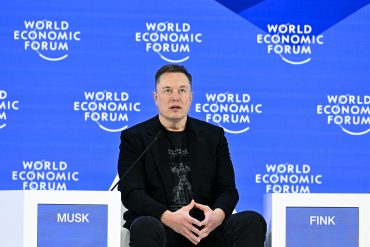
Yet technology’s prominence came with sobering qualifications. Elon Musk, whose enterprises span electric vehicles, space systems, and artificial intelligence development, projected AI surpassing human-level intelligence within two years while simultaneously identifying energy availability as the binding constraint. Tesla’s recent achievements lent credibility to both claims. The Cybercab autonomous vehicle launched in October. Megapack 3 energy storage systems drove utility-scale deployments up 130 percent quarter-over-quarter. The Optimus humanoid robot drew endorsements from Huang as commercially viable.
But Musk’s forecast that AI could automate 80 percent of jobs within a decade introduced uncomfortable economic realities. The Forum provided space to examine these tensions directly rather than retreating into comfortable abstractions about innovation and progress.
Infrastructure Reality Meets Computational Ambition
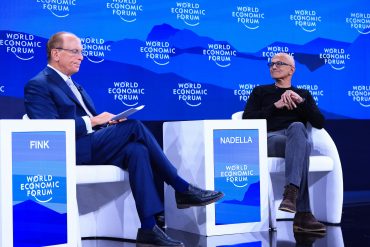
Microsoft’s Satya Nadella grounded the discourse in operational experience. Azure’s cloud segment expanded 31 percent in fiscal 2025 to $76.7 billion, driven overwhelmingly by AI workloads. Yet Nadella emphasized energy infrastructure as the decisive variable separating successful deployment from frustrated ambition. Regional disparities in power availability and capital access will determine which economies lead the next technological phase, a prospect with profound implications for competitiveness and development.
His framework prioritized utility over spectacle. Microsoft’s $10 billion investment in sustainable data centers, integration of AI tools into enterprise software through Copilot, and efforts to democratize access reflected deliberate choices about deployment strategy. Sessions with Amodei and Google DeepMind’s Demis Hassabis explored artificial general intelligence timelines, with projections ranging from five to ten years, but consistently returned to practical applications that could generate measurable societal gains in nearer timeframes.
This emphasis on constraint and feasibility distinguished the 2026 gathering from speculative exercises. IBM’s Arvind Krishna and Oracle’s Safra Catz addressed cloud sovereignty and infrastructure diversification, recognizing that concentration risks threaten resilience. Palantir’s Alex Karp warned of widening disparities between data-rich organizations and those lacking comparable analytical infrastructure, forecasting economic bifurcation that could exacerbate existing inequalities.
Investment patterns reflected these concerns. Global spending on AI-enhanced supply networks reached $20 billion in 2025, demonstrating corporate recognition that optimization extends beyond pure computation. Panels examining value chain resilience highlighted logistics applications already generating returns, providing concrete evidence that deployment need not wait for theoretical breakthroughs.
Capital Markets Navigate Transformation
Financial leaders brought disciplined perspective to technological enthusiasm. The Forum’s chief economists projected 3.2 percent global growth for 2026, buoyed by efficiency gains from AI deployment, but tempered optimism with warnings about asset valuations and concentration risks. BlackRock’s positioning under Fink’s leadership anticipated persistent volatility while projecting resilient flows into AI-themed funds, which attracted $150 billion in 2025.
Sovereign wealth managers from Norway’s Norges Bank Investment Management and Singapore’s Temasek engaged technology executives on capital allocation strategies that balance innovation potential against fiduciary responsibility. These exchanges produced nuanced assessments of sector dynamics, infrastructure requirements, and competitive positioning that pure financial analysis or technological evangelism alone cannot generate.
Markets registered measured confidence. The Nasdaq Composite gained 1.8 percent during Forum week, extending a rally built on sustained innovation expectations while incorporating new information about deployment timelines and energy constraints. The response suggested investors distinguished between hype cycles and fundamental capability shifts.
Dialogue as Strategic Asset
The renaissance of Davos resides less in any single insight than in the Forum’s restoration as a venue where competing perspectives achieve synthesis. Venture capitalists like Sequoia’s Roelof Botha explored biotech applications with pharmaceutical leaders such as Pfizer’s Albert Bourla, identifying precision medicine platforms moving from development to deployment. Energy executives examined data center power requirements with technology architects, translating abstract computational demands into concrete infrastructure projects.
This convergence matters because the challenges ahead require coordination that markets alone cannot orchestrate and governments cannot mandate. Energy infrastructure must evolve in parallel with computational capacity. Workforce development must anticipate rather than react to automation. Regulatory frameworks must enable innovation while managing concentration and displacement risks.
The Forum succeeded by creating conditions for honest assessment rather than performative optimism. Constraints received equal attention to capabilities. Implementation challenges earned as much consideration as technological breakthroughs. The result was dialogue that respected complexity without surrendering to paralysis.
As participants departed the Alpine enclave, the path forward remained demanding but discernible. Artificial intelligence presents genuine opportunity for productivity enhancement and economic transformation. Realizing that potential requires disciplined capital allocation, systematic infrastructure investment, and coordinated action across sectors and borders. Davos 2026 demonstrated the platform still functions when conditions demand it. Whether that momentum extends beyond Switzerland depends on execution the Forum can encourage but not compel.