- AI Infrastructure
- AI Investment
- Global AI Policy
India's AI Summit Signals a Shift in Global Tech Power
12 minute read
New Delhi’s AI Impact Summit secured landmark investment commitments, marking India’s transition from AI consumer to a principal shaper of global AI infrastructure and policy.
Key Takeaways
- India’s AI Impact Summit 2026 secured major infrastructure commitments from Reliance, Adani, and Tata, with the Tata-OpenAI deal representing one of the most substantive technology transfer arrangements between a Western AI company and an emerging-market conglomerate to date.
- The summit’s deliberate reframing from AI safety to AI impact reflects a coordinated policy stance: emerging economies are asserting that access to AI infrastructure and deployment capability is as urgent a priority as governance and risk containment.
- With heads of state from over 20 countries in attendance and UN Secretary-General Guterres delivering a keynote, India has established itself as the leading multilateral convener on AI outside the U.S.-Europe axis, a position with direct consequences for how global AI standards are written.
What the Summit Was and Why It Mattered
In a landmark convergence highlighting global AI capital reallocation, India’s AI Impact Summit 2026 has drawn an unprecedented assembly of world leaders, tech executives, and policymakers, channeling substantial investments into AI infrastructure and partnerships. This gathering positions India as a pivotal hub in redistributing AI resources from traditional centers to emerging economies, emphasizing sovereign capabilities, talent ecosystems, and adaptive regulations. The summit’s dialogues and commitments underscore that global AI capital reallocation is actively reshaping competitive landscapes, empowering Indian enterprises while compelling established players to recalibrate their strategies.
The event is the latest in a series that began with the UK’s Bletchley Park summit in 2023, followed by gatherings in France and Africa. Each prior summit centred primarily on safety and governance. India’s version explicitly reoriented the agenda toward deployment, infrastructure investment, and equitable access, a shift that reflects both India’s national interest and a broader frustration among emerging economies that AI governance conversations have been dominated by countries that already possess advanced AI infrastructure.
That reframing is consequential. Safety-first discourse tends to entrench incumbency: companies and countries with existing AI capabilities set the rules before others have meaningful capacity to participate. An impact-first agenda opens the negotiation to a different set of actors.

The Investment Commitments
The most concrete outcomes of the summit were commercial. Reliance Industries announced expanded commitments to AI-integrated data centers, leveraging its existing telecom infrastructure, which reaches several hundred million users across India. Adani Group outlined plans for large-scale sustainable AI facilities. Both announcements signal that Indian conglomerates are moving from AI adoption to AI infrastructure ownership, a structurally different position.
The Tata-OpenAI collaboration was the summit’s most significant deal. It encompasses data center co-development and the integration of ChatGPT Enterprise across Tata’s workforce operations. For Tata, a conglomerate spanning automotive, IT services, steel, and consumer goods, this is not an API licensing arrangement. It is an operational embedding of AI capability across business units, combined with infrastructure co-investment that gives Tata a degree of technical ownership rare among non-Western enterprise groups.
For OpenAI, the arrangement reflects the commercial logic of India’s scale. With one of the world’s largest and most linguistically diverse working populations, India represents both a major deployment opportunity and a critical source of training data variety. Deep operational partnerships are the mechanism through which OpenAI secures that access on preferential terms.
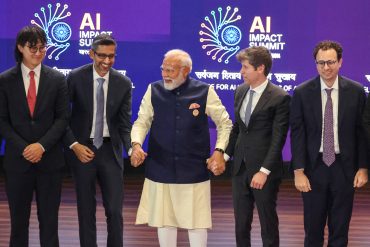
Google’s Sundar Pichai, Anthropic’s Dario Amodei, Google DeepMind’s Demis Hassabis, Meta’s Yann LeCun, Microsoft’s Brad Smith, and Qualcomm’s Cristiano Amon all participated. Their collective presence at a single non-Western AI forum of this scale was notable. It confirmed that New Delhi has successfully positioned itself as a venue where consequential AI business gets done, not merely discussed.
The Policy and Regulatory Dimension
India’s national AI mission, which prioritises building domestic compute capacity and technical skills, provided the policy backdrop for the summit’s commercial conversations. The government’s role as organiser and convenor meant that investment announcements were made within a framework of implicit regulatory alignment, giving foreign firms visibility into India’s policy direction while giving Indian enterprises the signal that government support for AI infrastructure is durable.
Nandan Nilekani’s focus on workforce reskilling addressed what is structurally the most complex challenge. India’s demographic scale is simultaneously its largest asset and its most significant exposure. AI-driven productivity gains in IT services, manufacturing, and agriculture will not automatically translate into broad-based employment growth. The summit surfaced this tension without resolving it, which is an accurate reflection of where the policy debate stands.
Investor reaction to summit-adjacent announcements from TCS and Infosys was positive. The market read the commitments as structural positioning rather than incremental news, consistent with the view that Indian IT services companies with deep enterprise relationships and proprietary India-specific data are well-placed to capture a large share of AI services revenue as deployment accelerates.

The Geopolitical Dimension
French President Macron and Brazilian President Lula both attended and spoke. Their participation was not incidental. For Macron, alignment with India on AI infrastructure reflects a shared interest in building alternatives to a global AI landscape defined exclusively by U.S. and Chinese platforms. France has pursued its own AI sovereignty agenda domestically; the India summit offered a multilateral extension of that posture.
For Lula and Brazil, the summit served as a reference point for how large emerging economies can participate in AI governance discussions with some structural weight behind them. The UN Secretary-General’s keynote reinforced the multilateral framing and gave the summit a degree of institutional legitimacy that bilateral gatherings cannot achieve.
The notable absences, Nvidia’s Jensen Huang and Bill Gates, generated comment but did not materially affect the summit’s outcomes. The decisions that mattered were being made by the executives and policymakers who were present.
An incident in which a university misrepresented a Chinese-built robot as an indigenous Indian development was a visible reminder that the gap between India’s AI ambitions and its current frontier capabilities remains real. It does not undermine the summit’s strategic significance, but it points to the work that domestic AI research and development policy will need to do in the years ahead.
Forward Implications
The summit’s long-term significance depends on execution across three areas. First, whether the infrastructure commitments from Reliance, Adani, and Tata translate into operational compute capacity at scale and on schedule. Second, whether the regulatory environment India develops proves adaptive enough to support rapid AI deployment while managing labour market transitions and data governance. Third, whether India can sustain its multilateral convening role in subsequent forums, converting this summit’s momentum into durable influence over how global AI standards are written.
The structural conditions are more favourable than they have been at any prior point. India’s policy continuity on AI, its large and technically trained workforce, its domestic market scale, and its diplomatic relationships across the democratic world and the Global South give it genuine leverage. The summit made that leverage visible to the international business and policy community in a concentrated and well-documented way.