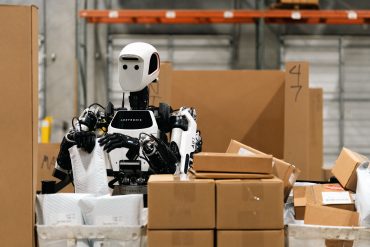
Google DeepMind Unveils Offline AI Model for Autonomous Robots
5 minute read
Edge computing robotics model empowers AI-powered machines to operate autonomously without internet connectivity, revolutionizing industrial automation
Three Key Facts
- Google DeepMind launches first cloud-free robotics AI model that enables autonomous robot operation without internet connectivity, addressing critical latency and privacy concerns in healthcare and manufacturing sectors.
- Market potential reaches $38-66 billion by 2035 according to Goldman Sachs and Fortune Business Insights projections, with the humanoid robot market showing nearly 50% compound annual growth rate.
- Training efficiency increases dramatically as developers can now optimize robots for new tasks using just 50-100 demonstrations through Google’s new SDK, compared to traditional slow reinforcement learning methods.
Introduction
Google DeepMind transforms the robotics landscape by releasing its first on-device vision language action model that operates without cloud connectivity. The breakthrough addresses fundamental limitations that have constrained robotic deployment in sensitive environments where reliability and privacy matter most.
Carolina Parada, head of robotics at Google DeepMind, leads this strategic shift toward edge computing in robotics. The development enables real-time decision-making in manufacturing facilities, healthcare settings, and personal assistance applications where internet dependency creates operational vulnerabilities.
Key Developments
The new Gemini Robotics On-Device model leverages multimodal AI capabilities to process text, images, audio, and video locally. This represents a significant departure from previous cloud-dependent systems that suffered from latency issues and connectivity requirements.
Google’s approach utilizes generative AI principles rather than traditional reinforcement learning methods. Google DeepMind reports that this methodology enables faster adaptation to new environments and tasks compared to conventional training approaches.
The company provides developers with a comprehensive SDK that requires minimal demonstration data. Parada confirms that robots can master new tasks through tele-operation sessions involving just 50 to 100 examples, dramatically reducing development time and costs.
Market Impact
Industry analysts project substantial market expansion following Google’s announcement. Goldman Sachs estimates the humanoid robot market will reach $38 billion by 2035, while Fortune Business Insights forecasts growth to $66 billion by 2032.
The technology sector responds positively to Google’s edge computing approach, recognizing its potential to accelerate commercial robotics adoption. McKinsey research indicates AI could contribute $4.4 trillion in productivity growth through corporate applications, with manufacturing representing a primary beneficiary.
Google positions itself to capture additional value across hardware and software ecosystems. The move extends the company’s AI dominance beyond search and cloud services into physical automation markets.
Strategic Insights
The on-device model addresses three critical barriers to robotics deployment: connectivity dependence, data privacy concerns, and real-time performance requirements. Healthcare facilities and manufacturing plants gain operational flexibility without compromising sensitive information security.
Google’s multimodal approach creates competitive advantages over traditional robotics companies focused on narrow task-specific programming. The Gemini integration enables robots to understand context and adapt to unexpected situations without human intervention.
The development signals broader industry transformation toward autonomous systems. Companies investing in edge AI capabilities position themselves advantageously as connectivity-independent robotics becomes the operational standard.
Expert Opinions and Data
Parada emphasizes the model’s contextual understanding capabilities, stating “When we play with the robots, we see that they’re surprisingly capable of understanding a new situation.” This adaptability distinguishes Google’s approach from rigid programming methodologies.
The safety framework incorporates multi-layered protection systems. “You are connecting to a model that is reasoning about what is safe to do,” Parada explains, addressing concerns about autonomous robot decision-making in complex environments.
Technical performance shows the on-device model operates with slightly reduced accuracy compared to cloud-based predecessors. However, the trade-off delivers significant advantages in reliability and privacy protection that outweigh marginal performance differences.
Industry experts acknowledge workforce implications as advanced robotics automate increasingly complex tasks. Proponents argue this transition frees human workers for creative and strategic roles, while critics highlight potential job displacement and regulatory challenges.
Conclusion
Google DeepMind’s cloud-free robotics model establishes new technical standards for autonomous systems while addressing fundamental deployment barriers. The development positions Google strategically in the expanding robotics market and demonstrates practical applications for edge AI computing.
The technology enables immediate implementation in privacy-sensitive and connectivity-challenged environments. Organizations can now deploy sophisticated robotic systems without compromising data security or operational reliability, marking a significant advancement in practical AI applications.