- Aerospace
- Aviation Markets
- Defense Industry
Dubai Airshow 2025: The Biggest Aerospace and Defense Deals
12 minute read
A breakdown of the biggest aerospace and defense deals at Dubai Airshow 2025, from widebody orders to major offset-driven military contracts.
Key Takeaways
- Dubai Airshow 2025 closed with $56.65 billion in total contracts, including Emirates’ $38 billion Boeing 777-9 order and $6.65 billion in UAE defense procurements, marking one of the largest combined aerospace–defense cycles in the event’s history.
- Gulf states and India shifted from buyer roles to co-architect roles, using contracts to extract technology transfer, local assembly, MRO facilities, and supply-chain integration, turning procurement into long-term industrial policy.
- Boeing, Airbus, Lockheed Martin, RTX, and Leonardo face a new competitive landscape where offset requirements, co-production deals, and localization mandates compress margins and reconfigure global aerospace and defense supply chains.
Introduction
The Dubai Airshow closed its 2025 edition with $56.65 billion in combined orders, a figure that obscures a more consequential shift beneath the transaction headlines. What emerged across five days of negotiations was not merely a procurement cycle but a recalibration of industrial leverage, as Gulf states and India employed purchasing power to extract technology transfers, manufacturing partnerships, and supply chain integration. For Boeing, Airbus, Lockheed Martin, and their defense counterparts, the event represented a strategic inflection point where volume matters less than the terms attached to each deal—and where regional buyers are no longer passive customers but active architects of their defense industrial bases.
The numbers tell part of the story. Emirates’ $38 billion commitment for 65 Boeing 777-9 aircraft dominated commercial tallies, while Tawazun Council channeled $6.65 billion toward defense systems spanning identification networks, helicopters, and sensor arrays. Yet the underlying architecture reveals something more intricate: a deliberate effort by Abu Dhabi, Riyadh, and New Delhi to monetize procurement into permanent capabilities. The UAE is embedding maintenance, repair, and overhaul facilities into commercial aviation agreements. Saudi Arabia is conditioning fighter acquisitions on domestic assembly lines. India continues leveraging its defense budget—2.4% of GDP and rising—to secure co-production arrangements that align with border security imperatives. This is procurement as industrial policy, and it carries implications that extend well beyond the $10 billion to $15 billion in direct economic activity these deals will generate over the next decade.
Commercial Aviation and the Offset Equation
Emirates’ widebody order exemplifies the new dynamics. The 777-9, powered by GE’s GE9X engine, addresses Dubai International Airport’s capacity constraints—passenger traffic reached 91 million in 2024—while offering Boeing a critical anchor amid ongoing certification delays and production bottlenecks. But the deal’s structure matters as much as its scale. Offset provisions reportedly include local MRO infrastructure capable of supporting approximately 3,000 jobs, alongside potential technology transfers in advanced composites that could reduce long-term fleet operating costs by 15% to 20%. For Boeing, this represents both revenue stabilization and strategic compromise: maintaining Gulf market share requires ceding elements of its value chain that were previously guarded.
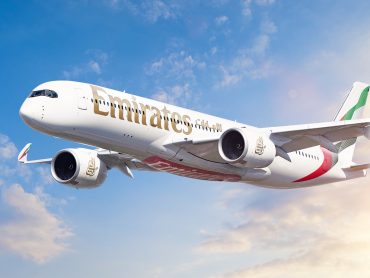
Airbus countered with its own narrowbody and widebody gains, though on a more modest scale. Emirates added eight A350-900s to an existing order book, bringing its total to 73 units and deepening its commitment to fuel-efficient long-haul operations amid persistent volatility in energy markets. The A350’s 25% fuel advantage over older widebodies aligns with Emirates’ hub economics, where marginal efficiency gains compound across high-frequency routes. Separately, Buraq Air’s commitment for 10 A320neo aircraft—estimated at $1.1 billion—signals Airbus’s continued penetration into secondary markets across North Africa, where the neo’s 20% fuel savings enable cost-competitive network expansion. Flydubai’s memorandum of understanding for up to 150 Boeing 737 MAX jets, valued at $13 billion, reinforces Boeing’s recovery trajectory while positioning Dubai to expand its low-cost carrier operations with potential 40% localization in sustainment and training.
These commercial agreements are conventionally viewed as airline fleet planning. They are better understood as infrastructure investments with geopolitical dimensions. Gulf carriers function as economic multipliers for their home states, and the offset provisions attached to these orders represent down payments on broader industrial ambitions. When Emirates negotiates MRO facilities, it is simultaneously building export capacity for third-party operators across the Middle East and Asia. When Saudi Arabia discusses Boeing 787 or 777 integrations under Vision 2030, it is targeting 50% localization of aviation expenditure and the creation of 10,000 jobs through maintenance hubs. The aircraft are enablers; the real asset is the ecosystem.
Defense Systems and the Integration Challenge
The defense portfolio at Dubai 2025 reflected a more fragmented landscape, though no less strategically significant. Leonardo’s joint venture agreement with the UAE’s EDGE Group—a 51/49 partnership launching in 2026—commits both parties to co-producing helicopters and defense systems in Abu Dhabi, with production technology transfers that position Leonardo for broader access to emerging markets. The economic logic is straightforward: Leonardo gains a manufacturing foothold in a region projected to generate $2 billion to $3 billion in defense exports by 2030, while the UAE acquires rotary-wing assembly capabilities that reduce dependency on European supply chains. Leonardo’s separate $117 million contract for five search-and-rescue helicopters with Abu Dhabi Police reinforces this trajectory, embedding the Italian firm deeper into Emirati operational infrastructure.
Raytheon Technologies, operating under the RTX banner, advanced its air defense integration agenda with a $60 million friendly force identification system for Abu Dhabi Police—modest in scale but indicative of a broader push toward networked warfare architectures. The company’s showcase of SPY-6 radars and hypersonic interceptors underscored its role in Gulf layered defense systems, which simulations suggest could reduce breach probabilities by 70% against drone and missile threats. With regional adversaries deploying over 500 drone incursions annually, these systems are less about theoretical deterrence and more about operational necessity. RTX’s coordination with Israel’s Rafael on Iron Dome expansions, valued at approximately $1.25 billion, positions the firm for $3 billion to $5 billion in follow-on contracts as the UAE and Saudi Arabia build out multi-tier defense shields.
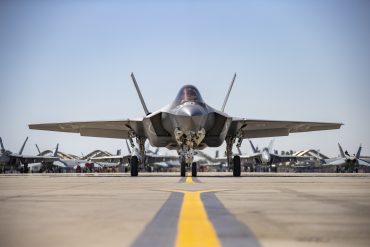
Lockheed Martin’s presence centered on stealth capabilities, with the F-35A Lightning II conducting aerial demonstrations that emphasized sensor fusion and network integration. The tactical message was clear: fifth-generation platforms enable 70% faster threat identification and response in joint operations, a metric that resonates in a region where response time can determine escalation trajectories. Saudi interest in a potential $10 billion to $15 billion acquisition of 48 F-35s remains conditional on U.S. export approvals, but the commercial groundwork is advancing. For Riyadh, securing F-35s would establish generational parity with regional adversaries and demonstrate Washington’s willingness to extend advanced capabilities to Gulf partners. For Lockheed, it represents market expansion at a moment when European F-35 orders have plateaued.
BAE Systems maintained a quieter profile, emphasizing radar upgrades and systems integration rather than headline-grabbing platforms. Collaborations with Saab and Boeing on advanced trainers suggest longer-term positioning around drone countermeasures and electronic warfare, areas where the UAE’s EDGE Group has accelerated indigenous development. BAE’s AESA radar arrays align with systems like EDGE’s AL HARRIS X, designed for short-range precision against proliferating drone threats. The opportunity here is not in selling platforms but in becoming the systems integrator for indigenous Gulf defense initiatives—a role that could yield $5 billion in regional contracts tied to localization mandates over the next decade.
Technology Previews and Future Trajectories
Beyond the transactional layer, Dubai 2025 functioned as a showcase for emerging capabilities that will define aerospace competition through 2035. EDGE unveiled 42 new systems, including AI-driven drones like the Jernas-M and space-based radar platforms, signaling the UAE’s intent to compete in autonomous and space-enabled warfare. RTX demonstrated digital ecosystems capable of simulating cyber threats in real time, while electric vertical takeoff and landing prototypes hinted at a hybrid urban mobility market projected to reach $200 billion by 2030. India’s Hindustan Aeronautics Limited displayed LiDAR systems with dual-use applications, reinforcing New Delhi’s strategy of leveraging defense R&D to seed commercial technologies.
These demonstrations matter not because they generate immediate revenue but because they establish capability benchmarks. When EDGE launches AI-guided munitions, it is signaling to traditional suppliers that Gulf states can develop alternatives. When India showcases LiDAR, it is demonstrating that technology access can be decoupled from Western dependence. For incumbents, this raises uncomfortable questions about pricing power and market durability in a multipolar defense landscape.
Capital Markets Exposure
The procurement architecture emerging from Dubai carries direct consequences for aerospace equity valuations and portfolio risk. Boeing and Airbus face margin compression as offset requirements force them to share high-value activities—composite manufacturing, avionics integration, systems maintenance—that historically commanded premium returns. Deferred revenue structures tied to multi-year technology transfer commitments will lengthen cash conversion cycles and complicate earnings visibility for analysts modeling out to 2030. Joint venture requirements introduce supply chain bifurcation that institutional investors must now price as operational risk: when Leonardo commits to 51/49 production sharing with EDGE, it accepts governance complexity and potential intellectual property leakage that standard contractor relationships avoid.
Perhaps most consequentially, the technology-for-offset dynamic is colliding with tightening U.S. export controls, particularly for systems governed by International Traffic in Arms Regulations and emerging Commerce Department restrictions on semiconductor and AI transfers. Lockheed’s F-35 negotiations with Saudi Arabia exemplify this tension—where commercial logic favors the sale but regulatory constraints may force restructuring or outright denial, creating valuation uncertainty for defense primes whose growth projections assume continued Gulf market access.

Structural Implications
The Dubai Airshow’s $56.65 billion headline understates its strategic weight. What transpired was a negotiation over industrial futures, where procurement became the currency for technology access, manufacturing capability, and supply chain resilience. Gulf states are no longer content with purchasing finished products; they are demanding—and receiving—the ability to produce, maintain, and eventually export defense and aerospace systems. This shift has compressed margins for traditional suppliers while creating opportunities for firms willing to embrace joint ventures and technology sharing.
For institutional investors and corporate strategists, the implications are clear. The aerospace market is bifurcating into platforms and ecosystems, with the latter commanding premium valuations as buyers prioritize integration over hardware. Companies that adapt to offset-driven models will capture sustained revenue streams; those that resist will face market share erosion in the world’s fastest-growing defense corridor. The next decade will determine whether Western aerospace giants can maintain dominance or whether they become component suppliers in industrial ecosystems controlled by their former customers.