- Agriculture Exports
- Asia-Pacific
- EV
- Global Trade
Carney Concludes Beijing Visit with EV and Canola Agreements
11 minute read
Ottawa’s first high-level China visit in eight years yields preliminary agreements on EVs, agriculture, and clean energy as bilateral relations enter a new chapter.
Key Takeaways
- Prime Minister Mark Carney’s January 2026 Beijing visit marks Canada’s most significant diplomatic engagement with China since the 2018 Huawei crisis, producing preliminary agreements on EV imports, agricultural tariffs, and clean energy cooperation projected to affect billions in bilateral trade flows.
- China’s commitment to reduce tariffs on Canadian canola seeds to approximately 15% by March 2026 addresses a major trade barrier affecting a $4.9 billion export market, with additional concessions on pork, seafood, and lobster creating new opportunities for Canadian producers.
- Carney’s meetings with executives from CATL, Alibaba, and Envision signal Canadian interest in attracting battery manufacturing and renewable energy investment, with EV supply chain development projected within three years under the preliminary framework.
The Beijing Meetings
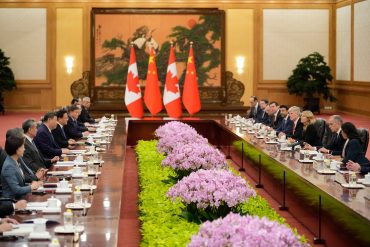
The Great Hall of the People has witnessed countless diplomatic moments over the decades, and the arrival of Canadian Prime Minister Mark Carney in Beijing, added another significant chapter to that history. His meeting with President Xi Jinping two days later represented the first encounter between the two nations’ leaders in eight years, a period marked by detained citizens, retaliatory tariffs, and substantially diminished bilateral engagement.
Carney brought to Beijing an economic strategy centered on trade diversification. With the United States pursuing tariffs on Canadian goods under the Trump administration, Ottawa has sought to expand commercial relationships beyond its southern neighbor. The prime minister’s stated objective of doubling non-U.S. trade within a decade finds concrete expression in these preliminary agreements with Beijing.
The timing reflects current trade dynamics. Canadian exports to China fell 10.4% in 2025, the first annual decline since the pandemic disrupted global commerce. The $118.7 billion trade relationship that existed in 2024 had contracted following successive rounds of protective measures, beginning with Canada’s decision to impose 100% tariffs on Chinese electric vehicles and 25% duties on steel and aluminum. Beijing responded with an 84% tariff on Canadian canola seeds, substantially affecting what had been a $4.9 billion export market in 2024, according to the Canola Council of Canada.
The Architecture of the Deal
The framework that emerged from four days of negotiations addresses prominent elements of recent trade friction while establishing mechanisms for broader cooperation. At its center sits an exchange of market access: China will reduce tariffs on Canadian canola to roughly 15% by March 1, 2026, with similar reductions applying to canola meal, pork, seafood, and lobster. In return, Canada has agreed to permit up to 49,000 Chinese electric vehicles annually at a reduced 6.1% most-favored-nation tariff, with provisions to expand this quota to 70,000 units over five years.
The EV arrangement reflects careful calibration against historical trade flows. Canada imported 41,678 electric vehicles from China in 2023, prior to the imposition of the 100% tariff. The initial quota of 49,000 units thus represents a modest expansion beyond pre-friction levels while remaining below 3% of Canada’s annual new vehicle sales. Incentives favoring affordable models priced below $35,000 respond to consumer interests, while requirements for joint ventures creating Canadian jobs and mandates that over half of imported EVs meet affordability thresholds within five years address industrial policy objectives.
Beyond these central provisions, the two sides signed eight memoranda of understanding spanning pet food exports, cultural exchange, tourism promotion, and the revival of ministerial dialogue mechanisms that had been inactive for nearly a decade. A joint clean energy plan emphasizes offshore wind and solar development while acknowledging transitional roles for fossil fuels.
Investment Signals
Carney’s itinerary extended beyond government meetings to include sessions with senior executives from several of China’s most prominent technology and energy firms. The prime minister met with leadership from Contemporary Amperex Technology (CATL), the world’s largest producer of electric vehicle batteries; Alibaba, the e-commerce and financial technology conglomerate; and Envision, a major player in renewable energy systems and smart battery technology.
These corporate engagements signal Canadian interest in attracting Chinese investment into domestic EV supply chain infrastructure. While no specific product launches or facility announcements emerged from the discussions, the preliminary framework anticipates EV supply chain development in Canada within a three-year horizon. Joint venture structures requiring Canadian job creation form part of this investment architecture, positioning the agreements as vehicles for manufacturing expansion rather than simple import arrangements.
The focus on battery technology carries particular significance. CATL’s dominant position in global battery production and Envision’s expertise in energy storage systems align with Canada’s stated interest in building domestic capacity across the EV value chain. The meetings also touched on broader clean energy cooperation, with renewable infrastructure representing a secondary but substantial area of potential investment flow.
Historical Context and the Path to Engagement
The significance of Carney’s visit becomes clearer against the backdrop of recent bilateral history. The December 2018 arrest of Huawei executive Meng Wanzhou in Vancouver, executed at Washington’s request, initiated a diplomatic rupture from which neither nation had fully moved forward. Beijing’s subsequent detention of two Canadian citizens for nearly three years deepened the estrangement.
Justin Trudeau’s government operated within constraints imposed by alliance commitments and domestic political dynamics. The subsequent alignment with American policy on EVs and metals in 2024 reflected these considerations. By the time Carney assumed office in March 2025, he inherited a trade relationship characterized by elevated tariffs and limited official communication.
The October 2025 APEC summit in South Korea provided an opportunity for direct engagement. Carney’s sideline meeting with Xi established preliminary contacts for the January visit, allowing both governments to assess mutual interests before committing to a formal state encounter. That preliminary dialogue informed the negotiations: the agreements reached in Beijing reflect months of preparation rather than outcomes assembled during the visit itself.
Market Responses and Sectoral Effects
Financial markets registered the announcements with varied responses. Shares in Canadian agricultural concerns, including Nutrien and major canola processors, rose between 3% and 5% on Toronto exchanges in the sessions following the deal’s outline. The prospect of improved Chinese market access carries particular relevance for prairie farmers, who have directed exports to alternative destinations during the tariff period. The scale of potential relief is substantial: restoring even partial access to the $4.9 billion canola market represents a material shift for the sector.
Chinese manufacturers also recorded gains. BYD and CATL saw advances on Shanghai indices, reflecting investor assessment that North American market access offers commercial value as competition continues in the global EV sector. CATL’s direct engagement with Carney during the visit underscored the company’s interest in the Canadian market, both as an export destination and as a potential site for manufacturing investment.
Broader market indicators showed mixed movements. The TSX Composite declined 0.8% amid ongoing attention to American tariff policy and its implications for the Canadian economy. The Canadian dollar strengthened marginally against the yuan, a movement analysts noted could shift in subsequent sessions as markets digest the political and commercial dimensions of the announcements.
Independent projections suggest the agreements could add between $2 billion and $3 billion annually to bilateral trade by 2028, though such estimates depend on implementation factors. The record of Canada-China commercial arrangements indicates that announced frameworks and realized outcomes can diverge depending on subsequent conditions.
Policy Considerations
For Ottawa, these agreements represent a step in the direction of trade diversification, signaling Canadian interest in developing commercial relationships across multiple markets. The approach involves balancing various interests: expanded export opportunities, domestic industrial considerations, and existing trade partnerships.
Washington may assess reduced barriers to Chinese EVs in light of its own trade policy objectives. American officials have previously expressed interest in coordinated approaches among allied nations regarding Chinese automotive imports. Canada’s quota system, while limited in scale, enters this policy environment. The implementation period will reveal how Ottawa navigates these intersecting considerations while maintaining cooperation with Washington on shared priorities.
From Beijing’s perspective, the agreements provide partial access to Canadian agricultural products during a period of attention to food supply stability. They also offer Chinese EV manufacturers a presence in the North American market and demonstrate Chinese interest in commercial partnerships with economies seeking diversified trade relationships.
Outstanding Elements
The preliminary nature of these agreements leaves substantial implementation work ahead. Human rights considerations, which featured in the post-2018 estrangement, did not receive detailed public treatment during the visit. Cybersecurity questions surrounding connected vehicle technology remain relevant given the EV sector’s increasing integration of digital systems. Intellectual property frameworks, a recurring topic in bilateral technology discussions, await further negotiation.
Carney characterized the partnership as pragmatic, a description that acknowledges areas of difference alongside areas of commercial alignment. The durability of economic ties built on selective cooperation while structural differences persist represents a question that implementation will gradually answer.
Broader Trade Patterns
The Beijing meetings reflect observable shifts in international commercial patterns. Multilateral trade frameworks face various pressures, and bilateral arrangements have become more prominent as nations pursue specific interests through direct negotiation.
For Canada, the visit represents a development in foreign policy approach. The agreements announced in January 2026 do not seek to recreate previous bilateral dynamics. They represent instead a defined relationship between nations with different systems and distinct obligations, each pursuing advantage where interests align while managing areas of difference. In a period of evolving global commerce, such arrangements constitute one available form of international economic engagement.
The relationship between Canada and China has entered a new phase. The implementation of announced frameworks over coming years will determine whether preliminary agreements translate into sustained commercial expansion, and how both nations navigate the various interests and relationships that shape their policy choices.