- AI Infrastructure
- Data Centers
- Energy Infrastructure
- Energy Policy
Big Tech Leaders Sign Power Pact With Washington on AI Energy
12 minute read
AI’s voracious electricity demands have prompted America’s biggest technology firms to fund their own power infrastructure, in a compact that reshapes Washington’s ties with Silicon Valley.
Key Takeaways
- The Ratepayer Protection Pledge commits seven major technology companies to financing dedicated power for their AI data centers, a structural shift that could decouple AI’s energy expansion from consumer electricity bills.
- Markets responded with measured optimism on March 4 and 5, with Oracle up 2.1% and Alphabet and Microsoft gaining modestly, reflecting investor confidence in policy clarity rather than exuberance.
- As a voluntary compact without binding regulatory teeth, the pledge’s credibility rests entirely on execution and on whether the administration can translate political momentum into lasting legislative infrastructure.
A Compact Forged in the State Dining Room
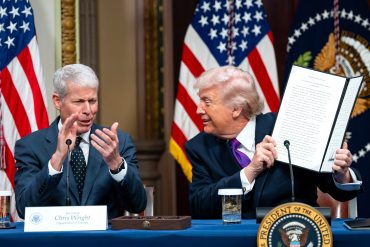
On March 4, 2026, the White House State Dining Room hosted an assembly whose significance was not ceremonial. President Donald Trump convened senior executives from Alphabet, Microsoft, Meta Platforms, Amazon, Oracle, xAI, and OpenAI to sign what his administration has branded the Ratepayer Protection Pledge, a commitment by each signatory to fund dedicated electricity generation for their data centers rather than drawing, at scale, from the shared grid that heats homes and powers hospitals. The setting was deliberate. These companies collectively represent the sharpest edge of American technological ambition, and their growing appetite for power has become one of Washington’s most politically sensitive infrastructure problems.
The pledge had its first public airing at Trump’s State of the Union address weeks earlier, framed as a safeguard against inflationary energy costs in a year shadowed by midterm contests. “This means that the tech companies and the data centers will be able to get the electricity they need, all without driving up electricity costs for consumers,” Trump said at the event, a formulation that is simultaneously a policy statement and a voter-facing guarantee. The timing was precise. Projections from the Electric Power Research Institute estimate that data centers could account for up to nine percent of total U.S. electricity consumption by 2030, a figure driven almost entirely by the computational demands of artificial intelligence. That trajectory, left unmanaged, carries meaningful political risk.
The Energy Arithmetic of Artificial Intelligence
The signatories arrive at this moment having already committed extraordinary capital to AI infrastructure. Alphabet has forecast expenditure of up to $185 billion in 2026, with a substantial portion directed toward data center construction. Microsoft’s Copilot-embedded enterprise products, now running on Intel Core Ultra Series 3 processors, represent the demand side of an equation that requires ever-larger power commitments on the supply side. Oracle, recognised in the 2026 Gartner Magic Quadrant for Source-to-Pay Suites, has deployed AI agents across supply chain workflows that depend on always-on cloud infrastructure. Each of these investments compounds the core problem: AI workloads are energy-intensive, geographically concentrated, and growing faster than grid planners had modeled even two years ago.
The pledge’s practical mechanism, requiring companies to build or contract for dedicated power rather than drawing incrementally from existing utility networks, attempts to shift the cost of this expansion from ratepayers to shareholders. For investors, that distinction matters. It converts what had been an ambiguous regulatory liability into a disclosed and manageable capital expenditure. It also removes one of the more credible risks to near-term AI valuation multiples: the possibility that grid constraints, or political backlash against rising household energy bills, would trigger restrictive federal intervention at an inopportune moment in the technology investment cycle.
Participants and Their Strategic Contexts
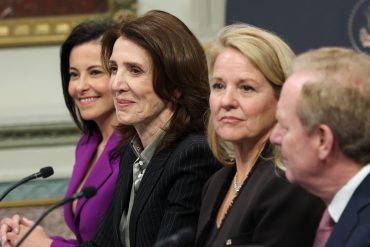
The executives in attendance represented firms at varying stages of their AI infrastructure build-outs, and the pledge carries different weight for each. Sundar Pichai’s Alphabet is investing in wearable AI interfaces, including Gemini-powered smart glasses developed with Warby Parker and Samsung, while its cloud revenues reached $17.7 billion in Q4 2025, a number that makes energy reliability a first-order operational concern, not an abstract sustainability goal. Satya Nadella’s Microsoft is embedding AI agents into Windows 365 environments and expanding Copilot functionality across enterprise software. Its agentic systems, which automate tasks from creative ideation to supply chain logistics, represent a category that cannot tolerate power interruptions.
Mark Zuckerberg’s Meta, whose Q4 2025 attribution enhancements drove a 24 percent uplift in incremental conversions on its advertising platforms, is developing new AI frameworks for image and text generation while preparing a 2026 smartwatch debut. Andy Jassy’s Amazon is pressing further into AI-optimised logistics and lifestyle consumer electronics, while Oracle is automating contract negotiations and maintenance workflows through embedded AI agents in its Fusion Cloud suite. Each of these product roadmaps generates energy demand that scales nonlinearly with adoption, making the pledge not merely a political accommodation but a rational pre-commitment by companies whose valuations depend on uninterrupted compute access.
The most unconventional presence at the table was Gwynne Shotwell, representing xAI following its February 2026 merger with SpaceX. Shotwell outlined plans for a 1.2 gigawatt primary power plant to support each supercomputer cluster, alongside an emerging model of orbital data centers designed to offload terrestrial energy loads altogether. Whether this remains a credible near-term engineering programme or an aspirational framing, it illustrates the degree to which the frontier of AI infrastructure planning has departed from conventional utility economics. xAI’s internal turbulence, with roughly half of its founding team having departed amid post-merger reorganisations, adds complexity to an entity that is simultaneously Elon Musk’s most ambitious enterprise and his most operationally unsettled.
Market Response and What It Signals
Financial markets greeted the news with discipline rather than enthusiasm. Nasdaq futures edged up 0.8 percent in after-hours trading on March 4. By early March 5, Alphabet shares had risen 1.5 percent, Microsoft 1.2 percent, and Oracle 2.1 percent, gains that reflect relief at policy clarity rather than exuberance about a novel growth catalyst. Amazon and Meta moved modestly upward. The measured nature of these reactions is itself informative: sophisticated institutional investors had already priced in some form of regulatory normalisation around AI energy policy, and the pledge confirms the direction of travel without resolving the underlying uncertainties about execution.
Oracle’s outperformance in the session is worth noting. The company’s February deployment of AI agents across supply chain platforms, combined with its Fusion Cloud updates addressing traceability demands in pharmaceuticals and process manufacturing, has positioned it as a beneficiary of enterprise AI adoption in regulated industries. The pledge’s alignment with Oracle’s cloud expansion strategy, which requires stable and scalable energy contracts, gives its commitment a degree of commercial coherence that is immediately legible to analysts.
The Rapprochement and Its Limits
The gathering also carried a political dimension that extends beyond energy policy. Trump’s first term was marked by recurring friction with large technology platforms over antitrust investigations, content moderation disputes, and regulatory posturing. That the same companies now appear at the White House as cooperative partners in a nationally significant infrastructure initiative reflects how substantially the political context has shifted. AI has become a sovereign competition issue: the administration frames American technological leadership as inseparable from national security, and the firms in that dining room are the vehicles through which that leadership is expressed.
Whether the pledge represents a genuine reset in the relationship or a tactical alignment of interests will become clearer as its terms encounter implementation. The critical limitation is structural: this is a voluntary compact. Without binding regulation, without penalties for non-compliance, and without an enforcement mechanism independent of the companies themselves, the pledge functions primarily as a statement of intent. Critics within the utility sector have noted that indirect grid costs, from interconnection queues, transmission upgrades, and demand spikes during construction phases, may still fall on ratepayers even when companies ultimately build dedicated generation. The administration has framed the political logic persuasively, but persuasive framing and durable policy architecture are rarely the same thing.
Execution as the Governing Variable
The ultimate measure of the Ratepayer Protection Pledge will not be found in the market moves of March 5 or in the language of the commitment itself. It will be found in whether, by 2028 or 2030, the companies that signed it have built, contracted, or financed sufficient dedicated power to honour its spirit, and whether the grid data of that period shows a meaningful decoupling between AI infrastructure growth and residential electricity price pressure. That is a high bar, and it spans administrations, regulatory cycles, and technology investment horizons that none of the signatories can fully control.
What the gathering did accomplish, unambiguously, is the elevation of energy policy to a strategic board-level concern for every major American AI company. The conversation has moved from sustainability reporting to capital allocation. From that perspective, the State Dining Room meeting of March 4, 2026, may matter less for what it committed to than for what it clarified: the energy cost of artificial intelligence is now a political, financial, and competitive variable of the first order, and Washington intends to hold the industry accountable for managing it.