- Apple
- Big Tech
- Business Strategy
- Tech Icons 500
How Apple Spent Fifty Years Becoming Impossible to Replace
14 minute read
From a Los Altos garage to 2.5 billion devices, the story of how design, silicon and services fused into the most unassailable franchise in modern business.
Key Takeaways
- Apple’s services segment, now generating over $109 billion annually at margins above 70%, has structurally recast the company from a hardware manufacturer into a compounding platform business with recession-resilient recurring revenue.
- The Jobs-Ive partnership was the defining creative and commercial force of Apple’s revival, embedding a design philosophy so institutionally deep that it continues to govern every product decision years after Ive’s departure as a full-time employee.
- With an installed base exceeding 2.5 billion active devices, a fortress balance sheet of over $130 billion in liquid assets, and M-series silicon that competitors have not matched, Apple enters its second fifty years from a position of structural advantage rarely seen in corporate history.
The Garage That Changed the Grammar of Technology
On April 1, 1976, in a modest garage in Los Altos, California, three men signed articles of incorporation for a computer company. One of them, Ronald Wayne, sold his 10% stake within a fortnight for $800. The other two stayed. That asymmetry of conviction is, in retrospect, as instructive as anything Apple ever built.
Fifty years later, Apple Inc. marks its anniversary not as a company looking backward but as one still moving with purpose. The occasion is significant not for what it commemorates but for what it demonstrates: that a single enterprise has navigated half a century of technological rupture, near-bankruptcy, the death of its founder and the full weight of global regulatory scrutiny, and arrived at its anniversary as the most valuable corporation on earth, with an ecosystem so deeply woven into daily life that abandoning it has become, for most users, genuinely inconceivable.
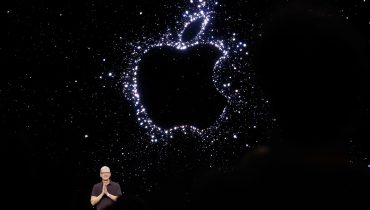
Tim Cook, writing in the official anniversary letter published on apple.com, framed the milestone with characteristic precision. “Fifty years ago in a small garage, a big idea was born,” he wrote. “Apple was founded on the simple notion that technology should be personal, and that belief, radical at the time, changed everything.” The language is not incidental. Cook is making an argument, not a toast. The argument is that the founding conviction has held across five decades and that it remains the company’s primary competitive asset.
That is a claim worth examining seriously, because the evidence supports it.
The Architecture of Reinvention
Apple’s history resists the clean narrative of linear progress. It is better understood as a series of deliberate reinventions, each one built on the intellectual foundation of the last but requiring a willingness to abandon what had made the previous era successful.
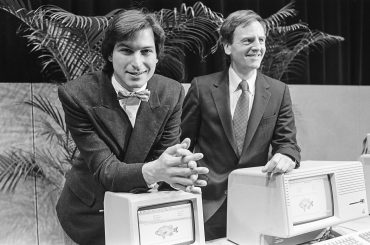
The Apple II, launched in 1977, introduced colour graphics and hardware expandability to a personal-computer market that had been the exclusive domain of hobbyists. The Macintosh of 1984, accompanied by one of the most celebrated advertisements in commercial history, brought the graphical user interface to a mass audience and established Apple’s enduring claim to the intersection of technology and culture. Then came the difficult years: internal fractures, the ill-fated Newton, the departure of Jobs in 1985 and a slow drift toward irrelevance that, by the mid-1990s, had left the company burning cash and losing ground to every competitor it had once outpaced.
The return of Jobs in 1997, through Apple’s acquisition of NeXT, is the most analysed episode in Silicon Valley history. What is less often examined with sufficient precision is the structural reason the revival worked, because charisma alone does not rebuild a company. What Jobs brought back was not simply vision but an organisational discipline that forced every product decision through a single question: does this serve the user, or does it serve us? That question, applied without compromise, produced a coherence that Apple’s competitors have spent billions trying to replicate and have not managed.

The Designer Who Rewrote the Product Language
Central to that coherence was a partnership that stands as one of the most consequential in modern industrial history. Jonathan Ive had arrived at Apple in 1992, a young industrial designer from London’s Central Saint Martins, working quietly within a company that had not yet found the discipline to match his standards. When Jobs returned, the two found in each other a shared vocabulary about what objects should feel like, not merely what they should do.
Ive’s appointment as senior vice president of industrial design set the terms for everything that followed. The iMac of 1998, translucent and coloured at a time when the industry had settled for beige, was the opening statement. It announced that Apple intended to compete on emotional register as much as technical specification, and that design was not a finishing coat applied to engineering but the governing logic of the entire product. The iPod in 2001 pressed the argument further. Its scroll wheel, its white earbuds and its insistence on absolute simplicity redefined portable music and, more importantly, demonstrated that hardware could anchor an ecosystem. The iTunes Store followed, and with it the template for everything Apple would build in the decades ahead.
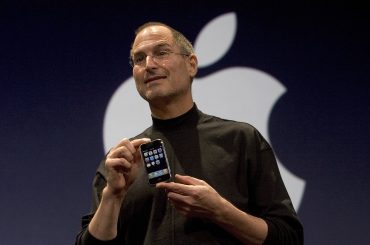
The iPhone in 2007 was the full expression of that template. A single slab of glass and aluminium that rendered every previous mobile device architecturally obsolete, it arrived not as an incremental improvement but as a categorical redefinition of what a phone was for. Ive’s influence extended beyond the product itself to the experience of encountering it: the packaging, the retail environment, the weight and finish of the object. Apple Park, the company’s headquarters in Cupertino, where the curve of a handrail and the calibration of natural light received the same attention as any circuit design, was the most ambitious expression of that sensibility applied at architectural scale.
Ive’s departure as a full-time employee in 2019, after nearly three decades, was received in some quarters as a structural risk. It has not proven to be one. Cook said at the time that Ive’s role in the company’s revival “cannot be overstated,” citing the groundbreaking iMac, the iPhone and the unprecedented ambition of Apple Park. Through LoveFrom, his independent creative collective, Ive has maintained selective ties with Apple as a client. More significantly, the design organisation he built continues to operate on the principles he established: materials chosen with obsessive care, manufacturing tolerances that exceed commercial convention, and a shared standard that objects should earn their place in a user’s life through the quality of the experience they enable, not through the number of features they carry.
The Platform Beneath the Products
Apple’s financial architecture today is most accurately described not as a hardware business with a services division, but as a platform business that uses hardware as its primary distribution and retention mechanism. The distinction carries significant implications for how the company should be valued and understood.
In fiscal 2025, iPhone net sales reached approximately $209.6 billion, the largest single line in total net sales of $416 billion. But the analytically more important number is the services segment: revenue that has grown at a compound rate outpacing hardware for several consecutive years, with gross margins routinely above 70%, compared with margins in the mid-30s on physical products. The App Store, through which developers have earned more than $550 billion since 2008, sits alongside Apple Music, iCloud, Apple Pay and Apple TV+ as the recurring-revenue layer that has structurally transformed the company’s earnings quality. An installed base exceeding 2.5 billion active devices is not merely a market-share figure. It is the measure of a distribution network that compounds with every product cycle, deepens with every software update and becomes more valuable as users accumulate history, preferences and dependencies within the ecosystem.
Geographically, the diversification reflects deliberate long-term construction. Americas generated the largest share of fiscal 2025 revenue, with Europe and Greater China contributing substantially. The concentration in China has attracted scrutiny, both from investors concerned about geopolitical exposure and from regulators on both sides of the Pacific. Tariffs introduced progressively from mid-2025 have added measurable cost pressure, a risk Apple has acknowledged explicitly in its annual filings. The company’s response has been to accelerate supply-chain diversification, including expanded production in India and Vietnam, without dismantling the Chinese manufacturing relationships that underpin its precision and scale.
The Quarter That Defined the Anniversary
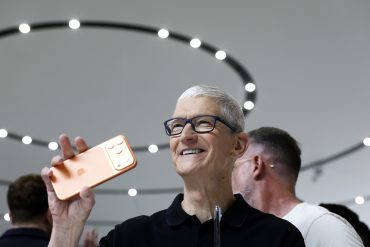
The first quarter of fiscal 2026, ended December 27, 2025, delivered the most instructive single data point of the anniversary period. Record net sales of $143.8 billion represented a 16% increase year on year. iPhone revenue surged 23% to $85.3 billion, driven by exceptional demand for the iPhone 17 family. Services reached an all-time high of $30 billion, up 14%. Net income rose to $42.1 billion, with diluted earnings per share climbing 19% to $2.84. Cook described it as the company’s best-ever quarter, noting records across every geographic segment.
Apple was founded on the simple notion that technology should be personal, and that belief, radical at the time, changed everything.
What the headline numbers do not fully capture is the structural health they reflect. Apple’s ability to deliver results of this quality at this scale, with services and hardware growing simultaneously, demonstrates an operational model that Cook has refined over fifteen years into something close to a precision instrument. Supply-chain discipline converts logistical complexity into competitive advantage. Product cycles are managed for margin integrity rather than volume maximisation. And the services business grows largely independent of which hardware generation is current, providing ballast against the cyclicality that affects every pure hardware manufacturer.
The early 2026 product launches, including the iPhone 17e, the MacBook Air with M5, updated MacBook Pro models with M5 Pro and M5 Max, a refreshed iPad Air with M4 and AirPods Max 2, maintained the cadence without disrupting the economics. They were not events designed to generate headlines. They were the regular expression of a machine that knows precisely what it is doing.
The Tests That Define the Next Chapter
Maturity at Apple’s scale brings pressures that no balance sheet fully neutralises. Antitrust scrutiny is the most structurally significant. The U.S. Department of Justice case and the European Union’s Digital Markets Act have compelled genuine architectural changes to App Store policies and sideloading requirements. The core economics have survived intact, but the regulatory environment is no longer a peripheral risk. It is a permanent feature of operating at this scale, in this many jurisdictions, with this degree of market influence.
Artificial intelligence presents a different order of challenge. Apple’s approach, centred on on-device processing under the Apple Intelligence framework, is both philosophically consistent with the company’s privacy commitments and commercially differentiated from the cloud-heavy strategies of its principal competitors. Whether that differentiation proves to be an advantage or a constraint as AI capabilities develop will depend on the pace at which on-device silicon can match the raw capability of data-centre infrastructure. The M-series chip programme gives Apple a genuine performance-per-watt lead. Sustaining it against competitors investing at scale in both hardware and foundational models will require the kind of long-cycle capital commitment that Cook’s organisation has historically managed well.
Vision Pro and spatial computing represent the most speculative line in Apple’s forward narrative. The device is expensive, the addressable market is nascent and the defining use cases have not yet crystallised. But the optical engineering, the visionOS software frameworks and the M-series platform beneath it are precisely the kind of patient infrastructure investment that has historically preceded Apple’s most transformative product categories.
Fifty Years of Earned Relevance
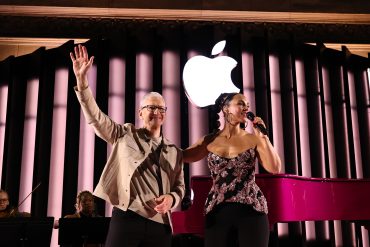
The anniversary celebrations reflected the tone Cook has set across his tenure: substantive rather than spectacular. A performance by Alicia Keys at the Grand Central Terminal store in New York, a remote opening-bell ceremony at Nasdaq, global events in Apple retail locations worldwide. The emphasis was on community and continuity. Cook’s letter extended gratitude explicitly to teams, developers and customers, to “the people and communities who have thought different with us.” For a company of more than 160,000 employees touching billions of lives through its products, the register was appropriate.
What the celebrations could not fully articulate, because no ceremony can, is the nature of the advantage Apple has built. It is not a product. It is not a brand, though the brand is extraordinary. It is a set of institutional standards, forged through the Jobs-Ive era and sustained under Cook, that govern how the company makes decisions at every level. The conviction that technology must feel inevitable rather than intrusive, that objects earn their place in a life through the quality of the experience they enable, and that relevance is never granted but always earned through relentless attention to the thing itself.
Fifty years after Wayne sold his stake for $800, that conviction remains the most valuable asset on Apple’s balance sheet. It appears in no filing. It cannot be quantified. And it is, ultimately, what has made the company impossible to replace.